A dual battery system can make an RV, camper van, or overlanding vehicle much more capable off-grid. It allows you to power refrigerators, lighting, fans, communication equipment, and other accessories without relying entirely on your vehicle's starting battery.
But adding an auxiliary battery is only part of the job. You also need a reliable way to recharge it while driving.
That's where a 12V DC-to-DC battery charger comes in.
Unlike a basic battery isolator, a DC-to-DC charger regulates the power supplied by the vehicle's alternator and applies an appropriate charging profile to the auxiliary battery. This is particularly important when using LiFePO4 batteries or vehicles equipped with smart alternators.
Some models also include an MPPT solar input, allowing the same unit to manage charging from both the alternator and solar panels.
We compared six DC-to-DC chargers from REDARC, Renogy, Victron Energy, and LiTime. The selection includes different charging currents, isolated and non-isolated designs, and models with and without integrated solar charging.
Important: This is a specification-based editorial comparison, not a hands-on product test. We have not independently tested charging efficiency, temperature performance, or long-term reliability. Specifications are based on manufacturer documentation and should be checked against the exact model and manual before installation.
Quick Comparison: 6 DC-to-DC Battery Chargers
| Charger | Output current | Solar input / MPPT | Notable feature |
|---|---|---|---|
| REDARC BCDC1225D | 25A | Yes | Vehicle installation, dual input |
| Renogy DCC30S | 30A | Yes | Smart alternator compatibility |
| Victron Orion-Tr Smart 12/12-30A Isolated | 30A | No | Galvanic isolation and Bluetooth |
| Victron Orion XS 12/12-50A | Up to 50A | No | Adjustable output and 98.5% maximum efficiency |
| Renogy RBC40D1U | 40A | No | Smart alternator support and Bluetooth monitoring |
| LiTime 12V 40A DC-DC with MPPT | 40A | Yes | Alternator and solar charging in one unit |
Solar input capabilities, output current, and charging profiles vary by model. A charger without MPPT requires a separate solar charge controller if you want to charge from solar panels.
Our Selected 12V DC-to-DC Chargers
1. REDARC BCDC1225D — Premium Dual-Input Charger for Vehicle Installations
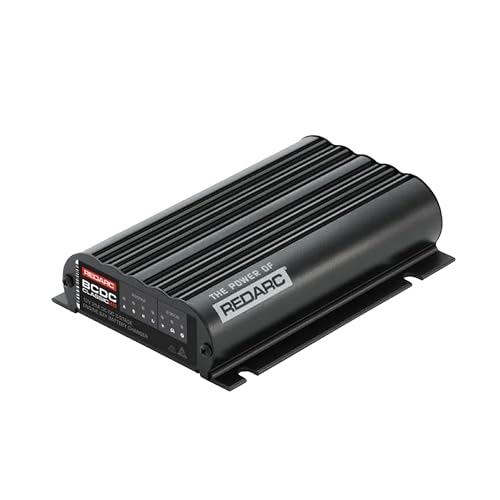
The REDARC BCDC1225D is a 25A DC-to-DC charger designed for vehicle-based auxiliary battery systems.
REDARC's BCDC range is built around charging a secondary battery from a vehicle's electrical system. The BCDC1225D also accepts solar input, making it possible to combine alternator charging and solar charging in one installation.
Key manufacturer specifications:
- Continuous charging current: 25A
- Vehicle input voltage: 9–32V
- Output: 12V auxiliary battery
- Compatible battery chemistries include: LiFePO4, AGM, gel, lead-acid, and calcium
- Integrated MPPT solar charging
- Dimensions: approximately 6.5 × 4.75 × 1.46 inches
- Weight: approximately 2.2 lb
- Manufacturer-listed warranty: 2 years
The BCDC1225D is designed for installation in the engine compartment. REDARC specifies a solar input voltage limit of 28V VOC for the 25A model, so panel selection and wiring must follow its solar input requirements.
Why consider it: It combines alternator and solar charging in a vehicle-oriented package. This can simplify a dual battery setup where space and installation location matter.
What to check: The 25A output is lower than the 30A, 40A, and 50A alternatives in this comparison. Make sure it can supply the charging rate your auxiliary battery system needs. Also verify solar panel open-circuit voltage, current, and power against the manufacturer's limits.
Manufacturer reference: REDARC BCDC1225D specifications.
Find the REDARC BCDC1225D on Amazon ↗
2. Renogy DCC30S — 30A DC-to-DC Charger With Integrated MPPT
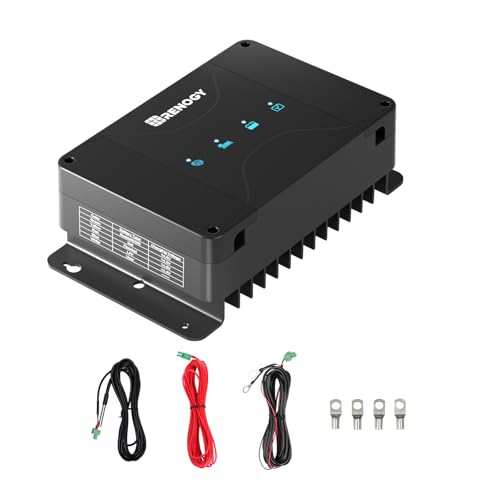
The Renogy DCC30S combines alternator charging and solar charging in one device.
It is designed for 12V auxiliary battery systems and provides a maximum charging current of 30A. Its integrated MPPT controller allows it to accept solar input without requiring a separate solar charge controller for that charging path.
Key specifications:
- System voltage: 12V
- Maximum charging current: 30A
- Battery types: AGM, sealed lead-acid, gel, flooded, lithium, and user-defined profiles
- Maximum solar input voltage: 30V
- Maximum solar input power: 400W
- Alternator input power: up to 400W
- Charging efficiency: 94% (manufacturer-declared)
- Dimensions: approximately 9.61 × 5.75 × 3.03 inches
- Weight: approximately 3.1 lb
- Manufacturer-listed warranty: 3 years
Renogy specifies compatibility with traditional alternators and smart alternators. Its published smart alternator input range is 12–16V, while the traditional alternator range is 13.2–16V.
Why consider it: The DCC30S is a practical option for an RV or overlanding system that needs both alternator and solar charging through one device.
What to check: Its 30V solar input limit is important. Do not select a solar panel based only on its nominal operating voltage. Check its open-circuit voltage (VOC), especially in cold conditions, and ensure the panel configuration remains within the charger specifications.
Manufacturer reference: Renogy DCC30S official specifications.
Find the Renogy DCC30S on Amazon ↗
3. Victron Orion-Tr Smart 12/12-30A Isolated — Configurable Charging With Galvanic Isolation

The Victron Orion-Tr Smart 12/12-30A Isolated is a DC-to-DC charger designed for systems where electrical isolation between input and output is required or preferred.
The isolated design separates the input and output electrically. This can be useful in installations with particular grounding or electrical architecture requirements.
Key specifications:
- Nominal system: 12V input to 12V output
- Continuous output current: 30A
- Input voltage range: 8–17V
- Adjustable output voltage
- Maximum efficiency: approximately 88%
- Galvanic isolation: 200V DC between input, output, and case
- Bluetooth configuration through VictronConnect
- Manufacturer documentation lists battery charging profiles and engine-running detection features
The Orion-Tr Smart uses configurable charging settings, which makes it suitable for different auxiliary battery chemistries when configured according to the battery manufacturer's requirements.
This model does not include an MPPT solar controller.
Why consider it: It is an interesting option for users who want an isolated charger with configurable charging parameters and Bluetooth setup.
What to check: The 88% maximum efficiency is lower than the manufacturer's published maximum for the Orion XS. Also, confirm that the isolated version is the correct electrical architecture for your installation. Victron sells both isolated and non-isolated Orion-Tr models, and they should not be treated as interchangeable.
Manufacturer reference: Victron Orion-Tr Smart Isolated specifications.
Check the Victron Orion-Tr Smart on Amazon ↗
4. Victron Orion XS 12/12-50A — High-Current Charging in a Compact Design

The Victron Orion XS 12/12-50A offers the highest charging current in this comparison.
It is designed for 12V systems and provides an adjustable charging current from 1A to 50A. Its high efficiency and compact enclosure make it an interesting option for more demanding auxiliary battery systems.
Key manufacturer specifications:
- Input voltage range: 9–17V
- Adjustable output voltage: 10–17V
- Adjustable current: 1–50A
- Continuous output power: up to 700W at 40°C under specified cooling conditions
- Maximum efficiency: 98.5%
- Bluetooth configuration through VictronConnect
- Protection rating: IP65
- Dimensions: approximately 5.4 × 4.85 × 1.6 inches
- Weight: approximately 0.73 lb
The Orion XS does not include an integrated MPPT solar controller. Solar charging requires a separate compatible solar charge controller.
Victron also specifies that the unit needs adequate free space and cooling. If airflow is restricted, the charger may reduce its output current earlier as temperature rises.
Why consider it: Its adjustable 50A output and high manufacturer-rated efficiency make it a strong candidate for systems with higher charging requirements.
What to check: A 50A charger is not automatically appropriate for every auxiliary battery. Confirm the battery's maximum permitted charging current, the alternator's available capacity, cable sizing, fuse requirements, and cooling conditions.
Manufacturer reference: Victron Orion XS technical specifications.
Find the Victron Orion XS on Amazon ↗
5. Renogy RBC40D1U — 40A DC-to-DC Charging Without Integrated MPPT

The Renogy RBC40D1U is a 40A DC-to-DC charger designed to charge an auxiliary battery from a vehicle alternator.
Unlike the DCC30S, this model does not include an integrated MPPT solar controller. If solar charging is part of your system, you will need a separate solar charge controller.
Key manufacturer specifications:
- System voltage: 12V to 12V
- Maximum output current: 40A
- Battery types: AGM, gel, flooded lead-acid, LiFePO4, and user-defined
- Traditional alternator input: 13.2–16V
- Smart alternator input: 12–16V
- Manufacturer-declared charging efficiency: up to 94%
- Dimensions: approximately 9.31 × 6.00 × 2.30 inches
- Weight: approximately 4.14 lb
- Bluetooth monitoring through Renogy's DC Home ecosystem
- Manufacturer-listed warranty: 2 years
The manufacturer documentation describes support for both traditional and smart alternators. Smart alternator installations require the appropriate ignition signal connection.
The unit also includes protection functions such as reverse polarity, overvoltage, over-discharge, overcurrent, and overtemperature protection.
Why consider it: The 40A output offers more charging current than the 25A and 30A alternatives, while the lack of integrated MPPT may be perfectly acceptable in a system that already has a separate solar controller.
What to check: Renogy's manual specifies wiring and fuse requirements for the 40A model. It also recommends checking alternator capacity before installation. Do not assume every vehicle alternator can support the additional charging load.
Manufacturer references: Renogy RBC40D1U specifications and official user manual.
Check the Renogy RBC40D1U on Amazon ↗
6. LiTime 12V 40A DC-to-DC Charger With MPPT — Combined Alternator and Solar Charging
The LiTime 12V 40A DC-to-DC Charger with MPPT is designed to combine alternator and solar charging for a 12V auxiliary battery.
Its integrated solar input and MPPT functionality allow the unit to manage charging from both sources.
Key manufacturer information:
- Nominal system voltage: 12V
- Maximum output current: 40A
- Compatible battery types include: LiFePO4, gel, AGM, and calcium
- Alternator and solar inputs
- Integrated MPPT solar charging
- Manufacturer-listed maximum efficiency: up to 93%
- Dimensions listed by the manufacturer: approximately 7.44 × 5.83 × 1.89 inches
- Weight: approximately 2.43 lb
The manufacturer lists several protection functions, including input overvoltage, output reverse connection, battery overvoltage, overtemperature, charging timeout, and BMS protection.
Why consider it: It combines two charging sources in a relatively compact product. This may be useful in a smaller overlanding or camper installation where reducing the number of separate components is desirable.
What to check: The product documentation consulted contains inconsistent solar input voltage information. We are therefore not publishing a definitive maximum solar voltage or power limit here. Verify the exact product revision and manual before choosing panels or wiring.
Manufacturer references: LiTime 40A DC-DC with MPPT and LiTime user manuals.
Find the LiTime 40A MPPT charger on Amazon ↗
DC-to-DC Charger With or Without MPPT: What's the Difference?
One of the most important decisions when choosing a charger is whether you want an integrated solar charge controller.
A DC-to-DC charger without MPPT uses the vehicle's alternator to charge the auxiliary battery. To add solar charging, you need a separate solar charge controller.
A dual-input DC-to-DC charger with MPPT can accept power from the alternator and solar panels, using its internal charging electronics to manage both sources.
| Feature | DC-to-DC only | DC-to-DC with MPPT |
|---|---|---|
| Alternator charging | Yes | Yes |
| Solar input | No | Yes |
| Separate solar controller needed | Yes, for solar charging | Usually not for the supported solar input |
| Installation components | More separate components | Potentially fewer components |
| Solar input limits | Determined by separate controller | Determined by charger specifications |
An integrated MPPT controller does not mean that any solar panel configuration will work. Always verify maximum solar voltage, maximum input power, polarity, and wiring requirements.
DC-to-DC Charger vs. Battery Isolator
These two devices are often confused, but they perform different functions.
A battery isolator connects or disconnects battery banks based on the electrical system's operating conditions. Its primary role is to manage the relationship between the starting battery and auxiliary battery.
A DC-to-DC charger does more: it regulates the charging process and provides a suitable charging profile for the auxiliary battery.
This difference matters when using lithium batteries and modern vehicles.
A smart alternator can vary its output voltage depending on operating conditions. A basic isolator may not provide the charging behavior required by a lithium auxiliary battery.
A DC-to-DC charger designed for the vehicle and battery chemistry can provide a more controlled charging process.
An isolator should not be considered a direct replacement for a properly specified DC-to-DC charger.
How to Choose the Right DC-to-DC Charger
Before purchasing, consider these five factors.
1. Charging Current
The charging current determines how much current the charger can supply to the auxiliary battery under its specified operating conditions.
The models in this comparison range from 25A to 50A.
A higher current rating can reduce charging time, but it also increases the demand placed on the vehicle's alternator and electrical wiring.
Check the auxiliary battery manufacturer's maximum charging current. A 50A charger may be unsuitable for a battery that permits a lower charging current.
2. Smart Alternator Compatibility
Many modern vehicles use smart alternators that adjust charging voltage to improve fuel efficiency and manage vehicle electrical systems.
A DC-to-DC charger must be compatible with the vehicle's alternator and use the appropriate ignition or signal connection where required.
Never assume that a charger designed for a traditional alternator will work correctly with every smart alternator.
Check the charger manual and vehicle documentation before installation.
3. Battery Chemistry
A charger should support the chemistry of the auxiliary battery.
Common options include:
- LiFePO4
- AGM
- Gel
- Flooded lead-acid
The charging profile must match the battery manufacturer's recommended voltage and charging parameters.
A lithium battery should not automatically be charged using a generic lead-acid profile.
4. Integrated Solar Charging
If you plan to use portable solar panels or roof-mounted panels, consider whether an integrated MPPT controller is useful.
A model such as the Renogy DCC30S combines alternator and solar charging. A model such as the Victron Orion XS focuses on DC-to-DC charging and requires a separate solar controller.
Neither architecture is universally better. The best choice depends on the electrical system you are building.
5. Installation and Thermal Management
DC-to-DC chargers can generate heat during operation.
Check the manufacturer's requirements for:
- Mounting location
- Ventilation
- Cable gauge
- Input and output fuses
- Grounding
- Maximum operating temperature
- Protection against moisture and vibration
For engine-compartment installations, use a charger specifically designed and approved for the intended environment.
Permanent vehicle electrical installations should follow the manufacturer's manual and applicable safety requirements. When in doubt, use a qualified installer.
Frequently Asked Questions
What does a 12V DC-to-DC battery charger do?
A 12V DC-to-DC charger transfers power from a vehicle's electrical system to an auxiliary battery while regulating the charging process. It can provide an appropriate charging profile for compatible battery chemistries, including LiFePO4.
Do I need a DC-to-DC charger for a dual battery system?
It depends on the vehicle, alternator, battery chemistry, and system design. A DC-to-DC charger is often a suitable choice for modern vehicles and lithium auxiliary batteries because it regulates the charging process.
Can a DC-to-DC charger work with a smart alternator?
Yes, if the specific charger is designed for smart alternator operation and is installed according to the manufacturer's instructions. Some models require an ignition signal wire or another method of detecting engine operation.
Can I charge my auxiliary battery from both solar panels and the alternator?
Yes. You can use a DC-to-DC charger with integrated MPPT, such as the REDARC BCDC1225D or Renogy DCC30S, provided your panels meet the device's input limits.
Alternatively, use a separate DC-to-DC charger and an independent solar charge controller.
Is a 40A DC-to-DC charger better than a 30A charger?
Not necessarily. A 40A charger can supply more charging current, but the battery, alternator, wiring, and fuses must all support the intended current. A 30A model may be a better match for a smaller battery or limited alternator capacity.
Does a DC-to-DC charger replace a solar charge controller?
Only if the charger includes an integrated solar charging function such as MPPT and its solar input specifications match the panels being used. A DC-to-DC-only charger does not replace a solar charge controller.
Does a DC-to-DC charger replace a battery isolator?
They are different devices. A DC-to-DC charger regulates charging, while an isolator manages electrical connection between battery banks. The correct solution depends on the electrical architecture of the vehicle.
Final Thoughts: Which DC-to-DC Charger Should You Consider?
The six chargers in this comparison serve different installation needs.
- For a vehicle-oriented premium dual-input charger: Consider the REDARC BCDC1225D.
- For a 30A charger with integrated MPPT: The Renogy DCC30S combines alternator and solar charging.
- For an isolated, configurable 30A system: Consider the Victron Orion-Tr Smart Isolated.
- For higher charging current and compact dimensions: The Victron Orion XS offers adjustable output up to 50A and a manufacturer-declared maximum efficiency of 98.5%.
- For a 40A charger without integrated MPPT: The Renogy RBC40D1U is worth comparing.
- For a 40A charger with integrated solar charging: The LiTime MPPT model offers an alternative, but its solar input limits should be confirmed against the exact manual.
There is no universal best DC-to-DC charger for every RV or overlanding vehicle.
The right choice depends on the vehicle's alternator, auxiliary battery chemistry, charging current requirements, solar configuration, available installation space, and electrical safety requirements.
Before purchasing, verify the exact model, manual, input limits, output current, warranty, and compatibility with your vehicle and battery.
Disclosure: As an Amazon Associate, CampWired earns from qualifying purchases. This article is a specification-based editorial comparison and does not represent hands-on testing of the products.
Specifications and marketplace listings can change. Confirm the latest information with the manufacturer and retailer before making a purchase.