A reliable dual battery system can make a major difference when you're overlanding, truck camping, or spending extended periods away from electrical hookups. It allows you to power accessories such as a 12V refrigerator, lighting, communication equipment, and other camping essentials without relying entirely on your vehicle's starting battery.
But choosing the right setup isn't as simple as buying a second battery. You also need a way to manage charging, protect both battery banks, and ensure that the components are compatible with your vehicle and battery chemistry.
In this guide, we'll compare five products that can serve different roles in an overlanding dual battery setup. They include DC-to-DC chargers, a solar-integrated charger, an isolated charger, and an automatic charging relay kit.
Important: These are not five complete, ready-to-install dual battery kits. Some are individual charging components, while the Blue Sea kit provides battery switching and isolation. Your complete installation will require additional components, including an auxiliary battery, appropriately sized wiring, circuit protection, and vehicle-specific installation work.
Quick Picks: Dual Battery Components for Overlanding
| Product | Best for | Main feature |
|---|---|---|
| Renogy DCC30S | Solar and alternator charging | 30A DC-DC with integrated MPPT |
| Victron Orion XS 50A | Higher charging capacity | Adjustable output up to 50A |
| REDARC BCDC1240D | 40A charging with solar input | DC-DC charger with MPPT |
| Blue Sea Add-A-Battery 7650 | Battery switching and isolation | Automatic charging relay |
| Victron Orion-Tr Smart 30A Isolated | Isolated installations | 30A isolated DC-DC charging |
How a Dual Battery System Works
A typical overlanding dual battery setup uses two separate battery banks:
- Starting battery: Powers the vehicle's engine-starting system and other factory electrical equipment.
- Auxiliary battery: Supplies power to accessories such as refrigerators, lights, and camping equipment.
A charging and battery-management component connects the two systems in a controlled way. Depending on the design, it may charge the auxiliary battery from the alternator, accept solar input, or manage when the two battery banks are connected.
There are two important approaches to understand.
DC-to-DC chargers
A DC-to-DC charger regulates the charging process between the vehicle's electrical system and the auxiliary battery. Many models support different battery chemistries and provide configurable charging profiles.
Some models also accept solar input, allowing the auxiliary battery to receive energy from both the vehicle and solar panels.
This approach is particularly relevant when using LiFePO4 batteries or vehicles with smart alternators. However, compatibility must be checked for the specific charger, vehicle, and battery combination.
Automatic charging relays (ACRs)
An automatic charging relay connects two battery banks when it detects a suitable charging condition and isolates them under other conditions.
This is a different approach from DC-to-DC charging. An ACR does not provide the same regulated charging profiles or integrated MPPT functionality as the DC-to-DC chargers in this comparison.
The appropriate solution depends on the battery chemistry, vehicle electrical system, and intended installation.
5 Dual Battery Products Worth Considering
1. Renogy Smart 30A DC-DC MPPT — Best for Alternator and Solar Charging
Product type: DC-to-DC charger with integrated MPPT
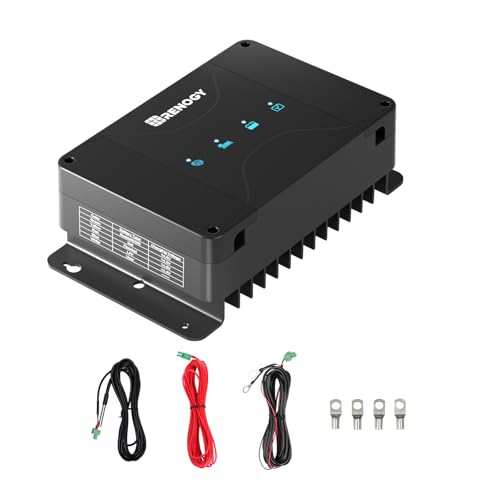
The Renogy DCC30S combines alternator-based charging and solar charging in one unit. For overlanders who want to charge an auxiliary battery while driving and also use portable solar panels at camp, this combination can simplify the charging architecture.
Its rated charging output is up to 30A, and the integrated MPPT controller supports solar input up to 30V and 400W.
Key specifications
- Charging output: Up to 30A
- System voltage: 12V
- Solar input: MPPT, up to 30V / 400W
- Supported battery profiles: AGM, sealed lead-acid, GEL, flooded, lithium, and user-configurable
- Alternator compatibility: Conventional and smart alternators, subject to the manufacturer's installation instructions
- Dimensions: 9.61 × 5.75 × 3.03 inches
- Weight: 3.13 lb
- Manufacturer warranty: 3 years
Renogy describes the package as including the charger, battery temperature and voltage sensors, and an ignition wire. The main power cables and fuses should not be assumed to be included.
For smart alternator installations, Renogy specifies using the IGN connection according to its instructions.
Why consider it?
The DCC30S is a practical candidate when alternator charging and solar charging need to be handled by one component. Its 30A output is also a useful reference point when planning a moderate-sized auxiliary battery installation.
Potential limitation: Confirm solar-panel electrical specifications, battery compatibility, wiring requirements, and alternator behavior before installation.
Check the Renogy DCC30S on Amazon ↗
2. Victron Energy Orion XS 12/12-50A — Best for Higher Charging Capacity
Product type: Configurable DC-to-DC charger

The Victron Orion XS is designed for installations that require a higher charging current and more control over charging parameters.
It supports adjustable output up to 50A and provides configuration through VictronConnect. Its published specifications include a maximum continuous output of 700W up to 40°C and maximum efficiency of 98.5%.
The charger also supports smart alternator installations through its engine-running detection and configurable charging behavior.
Key specifications
- Input: 9–17V
- Adjustable output: 10–17V
- Maximum output current: 50A
- Maximum continuous output: 700W up to 40°C
- Maximum stated efficiency: 98.5%
- Protection rating: IP65
- Bluetooth configuration through VictronConnect
- Dimensions: 137.3 × 123.1 × 40mm
- Weight: 0.33kg
- Manufacturer's standard warranty: 5 years
The Orion XS does not include an integrated solar MPPT controller. A separate solar charging solution is needed if solar charging is part of the installation.
Victron's installation documentation specifies an external fuse in the 60–70A range and cables sized according to installation distance. Do not assume these are included with the charger.
Why consider it?
The Orion XS is a strong candidate for users who want a compact, configurable charger with a higher current rating. Its adjustable output and monitoring capabilities make it particularly interesting for more carefully engineered installations.
Potential limitation: Its higher charging capacity does not automatically mean it is appropriate for every vehicle or battery. The alternator's available capacity, battery charging limits, cable sizing, and protection must all be considered.
Check the Victron Orion XS on Amazon ↗
Manufacturer technical specifications · Installation documentation
3. REDARC BCDC1240D Classic40 — Best 40A Option with Solar Input
Product type: DC-to-DC charger with integrated MPPT
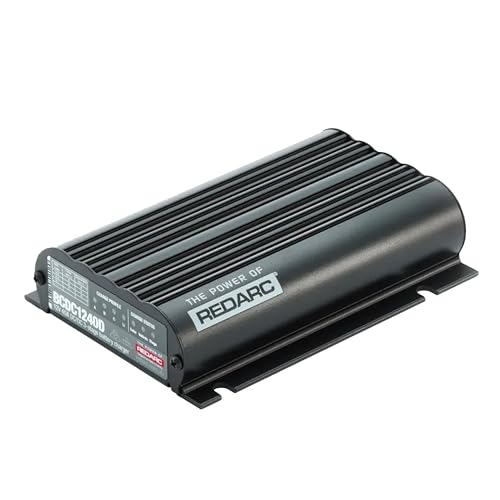
REDARC's BCDC1240D combines vehicle-based DC-to-DC charging with an integrated MPPT solar regulator.
The unit provides a 40A output and supports several battery chemistries, including LiFePO4, AGM, gel, lead-acid, and calcium batteries, according to the manufacturer's specifications.
Key specifications
- Output: 12V, 40A
- Rated power: 600W
- Vehicle input: 9–32V
- Solar input: MPPT, 9–32V
- Supported battery chemistries: LiFePO4, AGM, gel, lead-acid, and calcium
- Dimensions: 165 × 120 × 37mm
- Weight: 1kg
- Manufacturer warranty: 2 years
One important installation detail is that the manufacturer specifies a 60A input fuse that is not included and recommends its FK60 fuse kit.
There is also an important compatibility consideration: the specific North American product page describes this model as suitable for conventional alternator systems. Other REDARC materials discuss smart alternator compatibility across the BCDC range. Because of this distinction, verify the exact model revision and vehicle compatibility directly with REDARC before choosing it for a smart alternator installation.
Why consider it?
The BCDC1240D offers a combination of 40A charging and solar input in one component. It is worth considering for installations where both charging sources are part of the plan.
Potential limitation: Verify alternator compatibility for the specific vehicle, and account for the external fuse and wiring requirements.
Check the REDARC BCDC1240D on Amazon ↗
4. Blue Sea Systems Add-A-Battery Kit 120A — Best for Battery Switching and Isolation
Product type: Automatic charging relay and battery switching kit

The Blue Sea Systems Add-A-Battery 7650 takes a different approach from the DC-to-DC chargers in this guide.
It combines a Dual Circuit Plus 5511e battery switch with an SI-ACR 7610 automatic charging relay. The relay connects battery banks under charging conditions and isolates them when appropriate.
This makes it an interesting option for installations designed around battery-bank switching and automatic isolation.
Key specifications
- Kit: Add-A-Battery 7650
- Relay: SI-ACR 7610
- Switch: Dual Circuit Plus 5511e
- Current rating: 120A
- System voltage: 12V/24V
- Weight: 2.36 lb (1.07kg)
The kit does not include the batteries, complete installation wiring, or all required circuit protection.
It is also important not to assume that this ACR arrangement provides a suitable charging profile for every LiFePO4 battery. The manufacturer's kit specifications do not establish LiFePO4 compatibility for this application.
Why consider it?
The Blue Sea kit is useful for understanding an alternative dual battery architecture based on automatic relay control and switching rather than regulated DC-to-DC charging.
Potential limitation: It is not a DC-to-DC charger and does not include MPPT solar charging. Battery chemistry and charging requirements must be evaluated carefully before choosing an ACR-based installation.
Check the Blue Sea Add-A-Battery Kit on Amazon ↗
5. Victron Energy Orion-Tr Smart 12/12-30A Isolated — Best for Isolated Installations
Product type: Isolated DC-to-DC charger

The Victron Orion-Tr Smart 12/12-30A Isolated is a configurable DC-to-DC charger designed for applications where electrical isolation between the input and output is required.
It provides up to 30A of charging current and supports configurable charging profiles for lead-acid and lithium batteries.
Bluetooth connectivity allows users to configure and monitor the charger through VictronConnect.
Key specifications
- Input/output: 12V to 12V
- Maximum output current: 30A
- Rated output power: 360W
- Electrical isolation between input and output
- Configurable charging profiles
- Bluetooth configuration
- Smart alternator detection
- Manufacturer's standard warranty: 5 years
The isolated design can be useful in installations where electrical separation between battery banks is an explicit requirement.
It does not include an integrated MPPT solar controller. External wiring and fuses are required, and their specifications depend on the installation.
Why consider it?
This is a specialized option for users who need an isolated charging arrangement and want configurable charging behavior.
Potential limitation: Isolation is not necessary for every dual battery installation. Confirm that the vehicle and battery architecture actually require it before paying for this feature.
Check the Victron Orion-Tr Smart on Amazon ↗
DC-to-DC Charger vs. Automatic Charging Relay: Which Should You Choose?
These technologies serve different purposes. Choosing between them requires understanding the battery chemistry, alternator, and charging architecture.
| Feature | DC-to-DC charger | Automatic charging relay |
|---|---|---|
| Regulated charging profiles | Yes, depending on model | Not equivalent to DC-to-DC regulation |
| LiFePO4 charging profile | Supported by compatible models | Must not be assumed |
| Smart alternator support | Model-dependent | Depends on relay and vehicle behavior |
| Integrated MPPT | Available on selected models | No |
| Main function | Controlled charging | Battery connection and isolation |
A DC-to-DC charger is often the more appropriate starting point when the auxiliary battery is lithium-based or when the installation requires a controlled charging profile.
An ACR can be appropriate for a compatible battery architecture where automatic connection and isolation are the intended functions. It should not be treated as a substitute for a DC-to-DC charger without checking the battery manufacturer's charging requirements.
What Else Do You Need for a Dual Battery Setup?
Buying a charger or relay is only one part of the installation.
A complete setup typically requires:
- Auxiliary battery: Choose a battery with the right chemistry, capacity, physical dimensions, and charging requirements.
- Charging component: Select a compatible DC-to-DC charger or relay-based arrangement.
- Correct wiring: Cable gauge must be calculated based on current, cable length, installation conditions, and allowable voltage drop.
- Circuit protection: Fuses and protective devices must be selected and installed according to the component manufacturers' instructions.
- Battery mounting: The battery must be securely mounted and installed in a suitable location.
- Solar charging, if needed: A compatible MPPT controller or charger with integrated MPPT may be required.
The exact parts and installation procedure depend on the vehicle and the battery system. Follow manufacturer documentation and use a qualified installer when necessary.
How to Choose the Right Dual Battery Component for Your Vehicle
Before buying, answer these questions:
- Are you using an AGM, lead-acid, or LiFePO4 auxiliary battery?
- Does your vehicle have a conventional or smart alternator?
- How much charging current can the vehicle's electrical system safely provide?
- Will you use solar panels?
- Does the installation require electrical isolation?
- What are the battery manufacturer's charging limits?
These details matter more than choosing the product with the highest advertised current.
A 50A charger is not automatically better than a 30A charger if the alternator, battery, or wiring cannot safely support the higher output.
Frequently Asked Questions
What is the best dual battery system for overlanding?
There is no single best solution for every vehicle. The right setup depends on the auxiliary battery chemistry, alternator type, power requirements, and whether solar charging is needed.
Among the products compared here, the Renogy DCC30S offers integrated DC-to-DC and MPPT charging, while the Victron Orion XS provides a configurable output up to 50A.
Do I need a DC-to-DC charger for a dual battery system?
Not every installation uses one, but a DC-to-DC charger provides regulated charging between the vehicle electrical system and the auxiliary battery. It is particularly relevant when the battery requires a specific charging profile or when using a smart alternator.
Can I use a LiFePO4 battery in a dual battery setup?
Yes, provided that the charging components are compatible with the battery's requirements. Check the battery manufacturer's recommended charging voltage, current limits, and temperature restrictions.
Do not assume that every automatic charging relay is suitable for every lithium battery installation.
Can a dual battery system charge from solar panels?
Yes. Some DC-to-DC chargers include an integrated MPPT solar controller, such as the Renogy DCC30S and REDARC BCDC1240D compared in this guide.
Other installations require a separate solar charge controller.
Is a 50A DC-to-DC charger better than a 30A model?
Not necessarily. Higher current can reduce charging time when the entire system supports it, but the alternator, wiring, fuses, battery limits, and thermal conditions must all be considered.
Does a dual battery kit include the auxiliary battery?
Not always. The Blue Sea Add-A-Battery kit, for example, includes a switch and automatic charging relay, but not the batteries or a complete vehicle-specific installation.
Always check the package contents before purchasing.
Final Thoughts
A dual battery setup is one of the most useful electrical upgrades for extended overlanding and off-grid vehicle travel. But the best solution is not necessarily the one with the highest current rating or the most features.
Start with the auxiliary battery and your actual power requirements. Then select a charging architecture that is compatible with your vehicle and battery chemistry.
For a combined alternator and solar charging solution, the Renogy DCC30S is a strong candidate. For higher configurable charging capacity, the Victron Orion XS deserves consideration. And for installations based on automatic battery switching, the Blue Sea Add-A-Battery provides a different approach.
The most important step is to design the entire electrical system as a compatible installation rather than choosing individual components in isolation.
Affiliate Disclosure: CampWired may earn a commission when you purchase products through links on this page, at no additional cost to you. As an Amazon Associate, we earn from qualifying purchases.
Editorial Note: Product specifications in this guide are based on manufacturer documentation and available product listings. CampWired has not physically tested these products. Prices, availability, and customer ratings may change. Always verify current specifications and installation requirements with the manufacturer before purchasing.