A reliable battery is one of the most important parts of an RV or overlanding electrical system. It powers essential equipment when you are away from shore power, whether you are running a refrigerator, lights, fans, water pumps, communication equipment, or other 12V accessories.
For many mobile off-grid setups, a 12V lithium iron phosphate battery — commonly called a LiFePO4 battery — is worth considering. Compared with traditional lead-acid batteries, LiFePO4 batteries generally offer lower weight, higher usable capacity for a given nominal rating, and a different charging and maintenance profile.
But choosing the right battery is not simply a matter of buying the largest amp-hour rating you can afford.
Physical dimensions, continuous discharge current, battery management system (BMS), low-temperature charging protection, and compatibility with your RV or vehicle's charging equipment all matter.
We compared six 12V LiFePO4 batteries with different capacities and form factors. The selection includes compact 100Ah batteries, a model with integrated self-heating, and larger 165Ah and 200Ah options.
Important: This is a specification-based editorial comparison, not a hands-on product test. We have not independently tested these batteries under load or verified their real-world cycle life. Product specifications are based on manufacturer information and should be checked against the exact model and current product listing before purchase.
Quick Comparison: 6 12V LiFePO4 Batteries
| Battery | Capacity | Continuous discharge | Weight | Notable feature |
|---|---|---|---|---|
| LiTime Xtra-Mini 100Ah | 100Ah / 1,280Wh | 100A | 19.13 lb | Compact Group 22NF |
| ECO-WORTHY 100Ah Bluetooth | 100Ah / 1,280Wh | 100A | 23.15 lb | Bluetooth monitoring |
| Dyness AR1.2-MINI BT 100Ah | 100Ah / 1,280Wh | 100A | Approx. 20.94 lb | Group 24 format |
| LiTime 100Ah Self-Heating | 100Ah / 1,280Wh | 100A | 22.71 lb | Integrated battery heating |
| LiTime 165Ah Bluetooth | 165Ah / 2,112Wh | 165A | 32.15 lb | More capacity in Group 31 size |
| LiTime 200Ah Xtra-Mini | 200Ah / 2,560Wh | 200A | 44.5 lb | Highest capacity in this comparison |
Energy figures are nominal manufacturer ratings, calculated or declared at 12.8V. They do not represent guaranteed usable energy. Dimensions, specifications, and product availability should be confirmed before ordering.
Our Selected 12V LiFePO4 Batteries
1. LiTime 12V 100Ah Xtra-Mini — Compact Battery for Tight Spaces

The LiTime 12V 100Ah Xtra-Mini is the most compact option in this comparison.
Its Group 22NF form factor measures approximately 9.02 × 5.43 × 8.19 inches. That smaller footprint may be useful in truck campers, compact trailers, and custom overlanding builds where a standard battery enclosure does not fit.
Key specifications:
- Nominal voltage: 12.8V
- Rated capacity: 100Ah
- Nominal energy: 1,280Wh
- BMS: 100A
- Maximum continuous discharge: 100A
- One-second peak discharge: 500A
- Weight: 19.13 lb
- Protection rating: IP65
- Manufacturer-listed warranty: 5 years
- Bluetooth monitoring
LiTime also specifies low-temperature charging protection. Its published specifications indicate that charging is automatically stopped below 32°F (0°C) and resumes at or above 41°F (5°C).
Why consider it: Its compact dimensions and relatively low weight make it a candidate for installations where available space matters more than maximizing capacity.
What to check: Confirm that the Group 22NF dimensions, terminal position, cable clearance, and mounting arrangement fit your actual battery compartment. A smaller case does not automatically mean a compatible installation.
Check the LiTime Xtra-Mini on Amazon ↗
2. ECO-WORTHY 12V 100Ah Bluetooth — A 100Ah Alternative

The ECO-WORTHY 12V 100Ah Bluetooth battery is another option for RV and off-grid applications.
Its nominal specifications are similar to several other 100Ah batteries in this comparison: 12.8V, 100Ah, and 1,280Wh.
Key specifications published by ECO-WORTHY:
- Nominal voltage: 12.8V
- Rated capacity: 100Ah
- Nominal energy: 1,280Wh
- Maximum charge/discharge current: 100A
- Battery dimensions: approximately 10.2 × 6.6 × 8.4 inches
- Weight: approximately 23.15 lb
- Bluetooth monitoring
- Low-temperature protection
The manufacturer lists protection against overcharge, over-discharge, overcurrent, and temperature-related conditions. Its current product specifications list a charging temperature range beginning at 0°C. Check the exact manual for the model and revision you receive rather than relying on temperature figures from a different listing or version.
Why consider it: It offers a conventional 100Ah Group 24-style form factor and Bluetooth monitoring. It is worth comparing with other batteries in the same capacity range.
What to check: Confirm the exact low-temperature charging cutoff, warranty terms, and BMS operating limits in the current manual. The manufacturer's product information and marketplace listing should agree before you make a purchase decision.
Check the ECO-WORTHY 100Ah battery on Amazon ↗
3. Dyness AR1.2-MINI BT 12V 100Ah — Another Group 24 Option
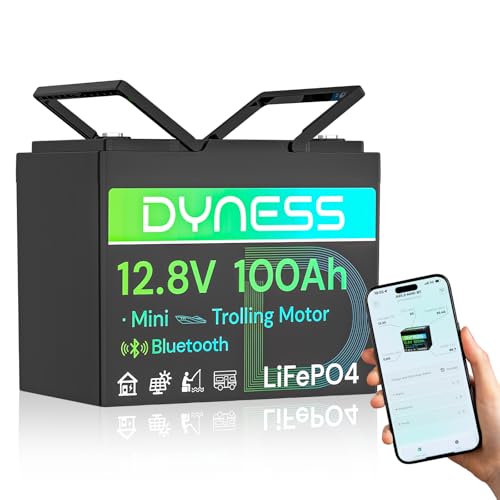
The Dyness AR1.2-MINI BT provides another 100Ah option in a Group 24-style enclosure.
The manufacturer's published specifications list:
- Nominal voltage: 12.8V
- Rated capacity: 100Ah
- Nominal energy: 1,280Wh
- BMS: 100A
- Maximum continuous discharge: 100A
- Maximum continuous charge: 100A
- Dimensions: approximately 10.24 × 6.61 × 8.23 inches
- Weight: approximately 20.94 lb (9.5 kg)
- Bluetooth monitoring
- Low-temperature protection
- Manufacturer-listed warranty: 5 years
The manufacturer also lists IP65 protection and a 14.4V ± 0.2V charging voltage.
Why consider it: It gives buyers another brand to compare in the 100Ah Group 24 category. Its published continuous discharge rating is documented, making the specification comparison more straightforward.
What to check: Verify the exact model number and manual supplied with the Amazon listing. Do not assume that every Dyness 12V battery has identical BMS limits, charging requirements, or application restrictions.
Check the Dyness AR1.2-MINI BT on Amazon ↗
4. LiTime 12V 100Ah Group 24 Self-Heating — For Cold-Weather Charging

The LiTime 12V 100Ah Group 24 Self-Heating battery is designed for users who need additional protection when charging in cold conditions.
Unlike a battery that only stops charging below a temperature threshold, this model includes an integrated heating function.
Key specifications:
- Nominal voltage: 12.8V
- Rated capacity: 100Ah
- Nominal energy: 1,280Wh
- BMS: 100A
- Maximum continuous discharge: 100A
- One-second peak discharge: 500A
- Weight: approximately 22.71 lb
- Dimensions: approximately 10.24 × 6.61 × 8.27 inches
- Bluetooth monitoring
- IP65 protection
- Manufacturer-listed warranty: 5 years
LiTime describes two heating modes. According to the manufacturer's documentation, the heating function activates when the battery is connected to a charger and its temperature is between approximately -4°F and 41°F (-20°C to 5°C). The battery heats before normal charging begins. The manufacturer lists a minimum charging current requirement for the heating function.
This distinction matters: self-heating is not the same as being able to charge normally at any sub-freezing temperature.
Why consider it: It is the most specialized choice in this comparison for RV owners and overlanders who regularly encounter freezing conditions and need to charge their battery in those environments.
What to check: Review the heating activation conditions, minimum charger current, energy used during heating, and installation requirements. The heating feature does not eliminate the need to follow the battery's operating limits.
Check the LiTime Self-Heating battery on Amazon ↗
5. LiTime 12V 165Ah Group 31 Bluetooth — More Capacity Without Moving to 200Ah
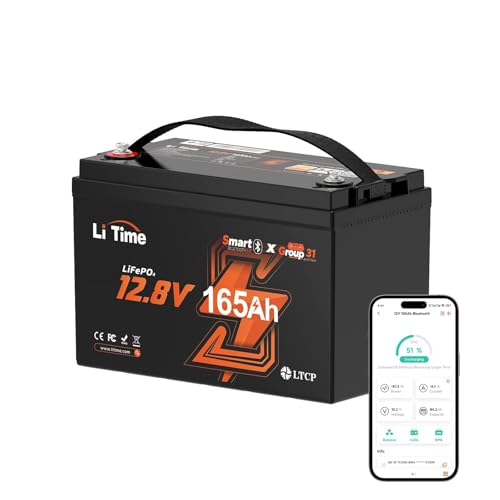
The LiTime 12V 165Ah Bluetooth battery sits between the 100Ah and 200Ah options.
It provides 2,112Wh of nominal energy in a Group 31-size enclosure.
Key specifications:
- Nominal voltage: 12.8V
- Rated capacity: 165Ah
- Nominal energy: 2,112Wh
- BMS: 165A
- Maximum continuous discharge: 165A
- One-second peak discharge: 825A
- Weight: approximately 32.15 lb
- Dimensions: approximately 13 × 6.77 × 8.5 inches
- Bluetooth monitoring
- IP65 protection
- Manufacturer-listed warranty: 5 years
The manufacturer specifies low-temperature charging protection. Its published charging range starts at 32°F (0°C), with charging recovery at 41°F (5°C). This model does not list integrated self-heating.
Why consider it: The 165Ah capacity provides more nominal storage than a 100Ah battery without moving to the physical size and weight of the 200Ah option.
What to check: Confirm the available space and mounting support. At 32.15 lb, it is heavier than the 100Ah models, and its installation should be designed for vehicle movement and vibration.
Check the LiTime 165Ah battery on Amazon ↗
6. LiTime 12V 200Ah Xtra-Mini — For Higher Energy Storage

The LiTime 12V 200Ah Xtra-Mini has the highest rated capacity in this comparison.
At 12.8V and 200Ah, the manufacturer lists 2,560Wh of nominal energy.
Key specifications:
- Nominal voltage: 12.8V
- Rated capacity: 200Ah
- Nominal energy: 2,560Wh
- BMS: 200A
- Maximum continuous discharge: 200A
- One-second peak discharge: 1,000A
- Weight: approximately 44.5 lb
- Dimensions: approximately 13.11 × 6.93 × 9.45 inches
- Bluetooth monitoring
- IP65 protection
- Manufacturer-listed warranty: 5 years
LiTime specifies low-temperature charging protection, with charging automatically stopped below 32°F (0°C) and resumed at or above 41°F (5°C). This model does not list integrated self-heating.
Why consider it: It offers the largest nominal energy capacity among the six selected batteries. That can be useful for systems with higher daily energy requirements, provided the rest of the electrical system is designed to support it.
What to check: Consider the battery's 44.5 lb weight, mounting location, cable sizing, fuse selection, and charging equipment. A larger battery does not automatically mean a better system if the charger, inverter, or wiring cannot support the intended loads.
Check the LiTime 200Ah battery on Amazon ↗
How to Choose the Right LiFePO4 Battery Capacity
The correct battery capacity depends on how much energy your equipment consumes and how long you need to operate without recharging.
A 100Ah battery may be enough for a simple setup with lights, fans, phone charging, and a 12V refrigerator. A larger system with multiple appliances, an inverter, or longer off-grid periods may require more storage.
Start by estimating your daily energy consumption.
A useful calculation is:
Watt-hours (Wh) = Volts (V) × Amp-hours (Ah)
For a nominal 12.8V LiFePO4 battery:
| Rated capacity | Nominal energy |
|---|---|
| 100Ah | 1,280Wh |
| 165Ah | 2,112Wh |
| 200Ah | 2,560Wh |
These are nominal figures, not guaranteed usable energy. Actual available energy depends on the battery's operating limits, BMS settings, temperature, discharge rate, and system losses.
Example: Estimate Your Daily Power Needs
Suppose your RV uses:
| Equipment | Estimated daily energy |
|---|---|
| 12V refrigerator | 500Wh |
| LED lighting | 60Wh |
| Ventilation fan | 120Wh |
| Phone and device charging | 80Wh |
| Total | 760Wh/day |
These are illustrative estimates, not measured consumption figures. Actual refrigerator consumption, in particular, varies with ambient temperature, thermostat settings, ventilation, and how often the lid or door is opened.
Once you estimate your daily consumption, decide how many days of autonomy you want and how much energy your solar panels or alternator charging system can replace.
Do not size a battery based only on its Ah rating. Consider the full energy budget and the charging opportunities available during your trip.
What Is a Battery Management System (BMS)?
A Battery Management System, or BMS, monitors and protects a lithium battery.
Depending on the battery design, its protection functions may include:
- Overcharge protection
- Over-discharge protection
- Overcurrent protection
- Short-circuit protection
- High-temperature protection
- Low-temperature charging protection
- Cell balancing
The BMS current rating is important because it limits how much current the battery can safely deliver or accept under the manufacturer's specified conditions.
For example, a battery with a 100A continuous discharge rating should not be treated as interchangeable with a 200A model simply because both have a 12.8V nominal voltage.
Also distinguish continuous current from short-duration peak current. A one-second peak rating does not mean the battery can supply that current continuously.
Your inverter, loads, cables, fuses, and other components must all be compatible with the battery's current limits.
Low-Temperature Charging: Why It Matters
Cold-weather operation deserves special attention when choosing a LiFePO4 battery.
Many conventional LiFePO4 batteries restrict charging below freezing temperatures. Discharging and charging are different operations: a battery may be able to supply power at temperatures where charging is not permitted.
There are two features to distinguish:
- Low-temperature charging protection: The BMS stops charging when the battery reaches a specified low-temperature threshold.
- Self-heating: An integrated heating system warms the battery before charging can proceed under certain cold conditions.
For an RV or overlanding vehicle used in winter, these features can make a practical difference.
However, self-heating does not mean unlimited cold-weather operation. Check the manufacturer's temperature limits, heating activation conditions, minimum charger current, and installation instructions.
Never bypass a battery's low-temperature protection to force charging.
Check Compatibility With Your RV or Overlanding Electrical System
A LiFePO4 battery is only one component of a complete electrical system. Before replacing an existing battery, check the compatibility of the other equipment.
Converter and Shore-Power Charger
Some RV converters are designed for lead-acid batteries and may not provide an appropriate charging profile for LiFePO4 batteries.
Check whether your converter supports lithium charging and whether its voltage settings match the battery manufacturer's recommendations.
Alternator Charging
If you plan to charge the auxiliary battery from your vehicle's alternator, verify that the charging system is compatible.
A properly selected DC-to-DC charger can regulate the charging process between the vehicle's electrical system and the auxiliary battery. This is especially important in modern vehicles with smart alternators.
Do not assume that connecting a lithium battery directly to any alternator is appropriate.
Solar Charge Controller
For solar charging, confirm that the controller supports LiFePO4 batteries and can be configured for the battery manufacturer's recommended charging parameters.
Also check the controller's maximum input voltage and current against the solar panel configuration.
Inverter and Wiring
If you use a 12V inverter, calculate the current required by the intended AC loads.
High-power inverters can draw substantial current from a 12V battery. The battery's continuous discharge rating, cable size, fuse, connections, and inverter specifications must be considered together.
For permanent RV or vehicle installations, use qualified electrical guidance and follow the relevant equipment manuals and applicable safety requirements.
Frequently Asked Questions
Is a 100Ah LiFePO4 battery enough for an RV?
It can be enough for a smaller RV electrical system, depending on daily consumption and charging opportunities. A system running a refrigerator, lights, fans, and small devices may fit within a 100Ah design, but the actual energy budget should be calculated before choosing a battery.
Is a 200Ah battery better than a 100Ah battery?
Not automatically. A 200Ah battery provides approximately twice the nominal energy of a 100Ah battery at the same nominal voltage, but it is also larger, heavier, and generally more expensive. The right capacity depends on your energy requirements, available space, and charging system.
Can I charge a LiFePO4 battery in freezing temperatures?
Only if the exact battery model and its manufacturer-approved heating or charging system permit it. Many LiFePO4 batteries stop charging below 32°F (0°C). Some models include self-heating, but they have specific activation conditions.
What does a 100A BMS mean?
It refers to the battery management system's current rating. For these products, the manufacturer may specify a maximum continuous charge or discharge current of 100A. Always check both values and distinguish them from short-duration peak current ratings.
Can I use a LiFePO4 deep-cycle battery as a vehicle starter battery?
Do not assume so. Deep-cycle batteries are designed for a different purpose from conventional engine-starting batteries. Use a battery specifically approved for starting applications if you need to crank an engine.
Can I connect two 12V LiFePO4 batteries together?
Some models support parallel or series configurations, but the permitted arrangement depends on the exact battery model and manufacturer instructions. Confirm compatibility, maximum battery count, wiring requirements, and configuration limits before connecting batteries. Do not assume that batteries with different capacities or models can safely be combined.
How long does a 12V LiFePO4 battery last?
Service life depends on cell quality, temperature, depth of discharge, charging conditions, current, storage, and maintenance. Manufacturers publish cycle-life ratings under specified test conditions, but those figures should not be interpreted as a guaranteed number of years in an RV or overlanding setup.
Final Thoughts: Which 12V LiFePO4 Battery Should You Consider?
The six batteries in this comparison serve different installation and capacity needs.
- For compact installations: The LiTime Xtra-Mini 100Ah has the smallest dimensions in this selection.
- For another conventional 100Ah option: Compare the ECO-WORTHY and Dyness models, paying attention to their manuals, warranty terms, and exact BMS specifications.
- For cold-weather charging: The LiTime 100Ah Self-Heating model is the only battery in this selection with an explicitly documented integrated heating function.
- For more capacity in a Group 31 format: The LiTime 165Ah provides a middle ground between 100Ah and 200Ah.
- For the highest nominal storage capacity in this comparison: The LiTime 200Ah offers 2,560Wh at a nominal 12.8V.
There is no universal best battery for every RV or overlanding build. The right choice depends on your power consumption, available installation space, climate, charging equipment, and budget.
Before purchasing, verify the exact model, current specifications, warranty, and compatibility with your electrical system.
Disclosure: As an Amazon Associate, CampWired earns from qualifying purchases. This article is a specification-based editorial comparison and does not represent hands-on testing of the products.
Product specifications and marketplace listings can change. Confirm the latest information with the manufacturer and retailer before making a purchase.